In today’s world, where technology quietly powers almost everything around us, temperature measurement plays a surprisingly central role. From your smartphone to industrial machinery, the ability to monitor heat accurately is essential. That’s where temperature sensors come into the picture—simple in concept, yet incredibly powerful in application. And when combined with a well-designed science model, they become even more fascinating to understand and demonstrate.
What Are Temperature Sensors?
At their core, temperature sensors are devices that detect and measure heat or cold within an environment. They convert temperature readings into signals—usually electrical—that can be interpreted by humans or machines. There are different types, such as thermistors, thermocouples, and resistance temperature detectors (RTDs). Each works slightly differently, but the goal remains the same: provide accurate temperature data.
For example, a thermistor changes its resistance based on temperature. As heat increases, resistance drops (or rises, depending on the type), and that variation is measured. It’s a neat little trick of physics being used in everyday devices.
Related brief: Building Security Governance That Drives Real Protection
Why Temperature Sensors Matter
You might not notice them, but temperature sensors are everywhere. They regulate air conditioners, monitor engines, protect electronic circuits, and even help in medical devices. Without them, many systems would either fail or operate inefficiently.
Think about a refrigerator. It doesn’t just stay cold magically. A sensor constantly checks the internal temperature and signals the system when cooling is needed. This kind of automation is only possible because of precise temperature sensing.
Role of Sensors in a Science Model
When it comes to education, integrating sensors into a science model can make learning much more interactive. Instead of just reading about temperature changes, students can actually see real-time data and understand how systems respond.
A simple science model using a temperature sensor might involve a heat source, a sensor, and a display unit. As the temperature rises, the sensor detects the change and sends a signal to the display, showing the variation instantly. This hands-on approach helps bridge the gap between theory and practical understanding.
Types of Temperature Sensor-Based Models
There are many creative ways to design a science model around temperature sensing. Some popular examples include:
1. Smart Room Temperature Monitor
This model demonstrates how a room’s temperature can be tracked continuously. It can even be extended to control a fan or heater automatically.
2. Fire Alarm System
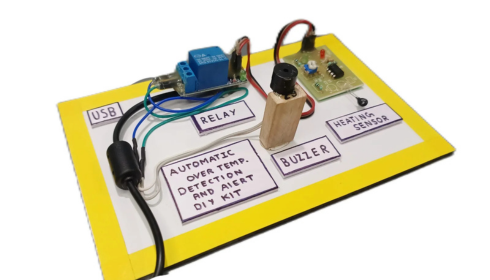
A temperature sensor can detect sudden spikes in heat, triggering an alarm. It’s a great way to explain safety systems.
3. Weather Station Prototype
By combining temperature sensors with other components, students can build a basic weather monitoring system.
Each of these models shows how temperature data can be used in real-world scenarios.
How It Works in Practice
In a typical setup, the sensor is connected to a microcontroller like Arduino. The sensor reads the temperature and sends data to the controller, which processes it and displays it on an LCD or sends it to a computer.
What makes this interesting is how quickly the system reacts. Even a small change in temperature is detected almost instantly. This responsiveness is what makes temperature sensors so valuable in both small-scale projects and large industrial systems.
Educational Benefits of Using Science Models
Using temperature sensors in science models isn’t just about building something cool—it’s about understanding concepts deeply. Students learn about:
- Heat transfer
- Electrical signals
- Data interpretation
- Automation logic
It also encourages problem-solving. Sometimes the readings aren’t accurate at first, and students have to figure out why. That trial-and-error process is where real learning happens.
Final Thoughts
Temperature sensors may seem like small components, but their impact is massive. When paired with a thoughtfully designed science model, they turn abstract concepts into tangible experiences. Whether you’re a student, teacher, or just someone curious about technology, exploring these models can open up a whole new perspective on how the world works—quietly, precisely, and intelligently.